Overview
The Massachusetts Bay League (MBL) is an organization of more than 30 varsity or club sailing teams‚ including about 400 boys and girls‚ from public and private schools in the Boston metropolitan area. Our mission is to further the sport of competitive and recreational sailing in secondary schools throughout the region.
The largest and oldest local group of high school sailing teams in the country‚ it was formed in 1977 with the participation of only seven schools. While schools have come and gone over the decades since‚ more than half of the league’s members continue to be teams from public schools.
The fall sailing season‚ in which only a subset of teams participate, is mostly devoted to learn-to-sail instructional activities and fleet race regattas. In the spring season (late March to late May)‚ the main activity is competitive team racing but there are several fleet race regattas as well. The teams are divided into divisions that may change over time and may be based on various things including ability‚ location‚ resources, etc. There are several annual sailing events and regattas and qualifiers for regional or even national events. Our two-day Carl Zimba Fleet Racing Championship at the end of the spring season may be the largest high school regatta in the country involving four fleets, up to 80 boats, and nearly 200 sailors.
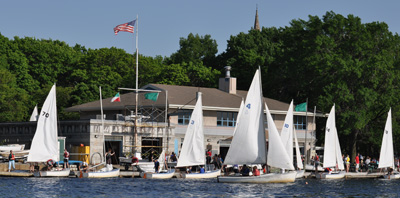
For more than 35 years‚ the league used Community Boating‚ Inc. in Boston (CBI) as a primary venue. For much of this period‚ the MBL was the exclusive representative of scholastic sailing at Community Boating‚ and the two organizations cooperated in planning and supporting a 420 fleet. In the fall of 2012‚ Community Boating elected to terminate this relationship. After that‚ the league had no formal connection to Community Boating but several Division C teams continue to sail there and receive “learn-to-sail” instruction and fleet racing experience. In addition‚ the MBL Championship event continues to utilize the CBI venue.

The majority of MBL teams are members of the New England Schools Sailing Association, NESSA, and the national Interscholastic Sailing Association, ISSA. In recent years‚ our teams have become more frequent qualifiers for the NESSA Team Racing Championship and the NESSA Fleet Racing Championship‚ both qualifiers for national championships. Duxbury High School became the first public school to win the team race championship and has qualified for the fleet race nationals and the single–handed nationals. Hingham High School and Duxbury won the New England Women’s Invitational. Buckingham‚ Browne & Nichols School won a NESSA singlehanded championship and qualified for the nationals in that event. We've come a long way!
Governing Rules and By-Laws
All sailing is governed by the Racing Rules of Sailing (RRS) which are revised and published every four years by the International Sailing Federation.
Unlike most other high school sports, sailing is not governed by the Massachusetts Interscholastic Athletic Association (MIAA), nor is sailing governed by the New England Preparatory School Athletic Council (NEPSAC) or by the Independent School League (ISL). Instead, high school sailing in the MBL is governed by the New England Schools Sailing Association (NESSA), the national Interscholastic Sailing Association (ISSA), and its own by-laws and procedural rules.
Even though sailing is not officially governed by the MIAA, the league follows most of the MIAA guidelines and policies with some notable exceptions. e.g. Sailing outside of the state is allowed without restriction under MBL policies. There are both fall and spring seasons, the same person may coach both seasons, and there is no prohibition by the MBL of coaching students out of season. Please note that individual school’s athletic departments may enforce other rules.
See below for the sailing-specific rules and by-laws the Massachusetts Bay League teams are guided by:
MBL Procedural Rules (At team level and sub-division level)
FAQs
1.) What kind of boats are typically sailed?
Most teams in New England sail in 420s, a high performance two-person dinghy. In the MBL, teams sailing at Community Boating may also sail Cape Cod Mercuries, another two person boat. While slower than a 420, a Mercury is a good, more stable boat for novice and intermediate sailors.
2.) Is MBL sailing co-ed?
Yes. Sailing is one of the few high school sports that is truly co-educational. Most teams have both boys and girls competing together, although a few of our schools are all-male or all-female. All events are open to teams with both girls and boys. The sole exception is a women's invitational regatta that is for girls only.
3.) How does the MBL manage so many far-flung teams with varying skill levels?
Team are indeed widely dispersed, their recources vary greatly, and the sailors range from advanced beginners to highly skilled sailors with a good amount of experience in competitions. To manage all this, sub-divisions have been created and are revised as necessary on an annual basis. See Sections 2 and 9 of the MBL Procedural Rules for the current organizational constructs and associated rules.
4.) Where do teams sail?
A subset of our member schools, those in the C Division, sail at Community Boating on the Charles River in Boston. The remaining schools sail at various venues throughout eastern Massachusetts.
5.) My school does not have a sailing team. Can I still participate in the MBL?
The league is an organization of schools with school sponsored sailing teams, and we are not able to accept individuals as members. A new sailing team at your school can be formed, and the MBL is also willing to accept a composite team formed by pooling students from two or more schools to compete as a unified team. A composite team must be formally sanctioned by all of the schools whose students make up the team. For more on starting a team, see the Member Info section.
6.) Can sailing be a varsity sport even though it is not an MIAA sport?
Yes. Most of our member schools have sailing teams at the varsity level. For other schools, the sailing team is a club activity. It is up to the school to decide if the sailing team should be recognized as a varsity level sport or club. The MBL treats each sailing team equally, making no distinction between varsity level teams and club teams.
7.) Are uniforms required?
No, but some schools do have matching spray tops, life jackets, pinnies, or bibs. Also, most teams have their sailors wear pinnies with their school's unique design during competitions.
8.) What is the typical race course?
There are a lot of different courses that can be used. The simplest race courses are the port triangle and windward-leeward, rounding the buoys to port (left for you landlubbers). For both of these courses, the start-finish line can be at the leeward (downwind) end of the course (standard course) or at the middle of the upwind leg (modified course). Another variation is with the start line at the leeward end and the finish at the windward (upwind) end. These two simple courses can also be combined so that the first lap is a port triangle and second lap is windward-leeward.

For team racing, the digital N or collegiate N are frequently used. The first leg is upwind. At the top of the first leg, there are two marks, separated by a few boat lengths, which are rounded to starboard (right). The next leg is downwind. At the bottom of this third leg, there can be either one (collegiate N) or two buoys (digital N), which are rounded to port. The last leg is upwind.
- This box course requires two standard marks and two marks with anchors sufficient to anchor the committee boat. The committee boat needs to move from the start to the finish line. The course needs to be long and narrow so that the downwind leg is a run and not a broad reach.
9.) Do your sailing teams have championship competitions?
Yes, at a few different levels…
Within the MBL, we have a fleet racing championship each May and also hold annual team racing invitationals by division where the better teams compete for a trophy. At the state level, there is the Massachusetts State Open Championship which is hosted by MIT Sailing. This event is open to any school in the state and is considered to be a state championship even though many of the best teams in the state typically do not participate due to travel and scheduling issues.
For MBL teams that join NESSA…Within the six New England states, there are championship regattas for fleet racing and team racing in the spring and for single-handed Lasers in the fall. In recent years, the fleet racing championship has involved nearly 60 teams competing in a 2-day event. For the team racing championship, teams are selected for a 2-day regatta using a computer ranking system and a poll of select coaches.
Sailing is also one of the few, perhaps only, high school sport that crowns a national champion. Each of the seven regional districts sends one or more teams to the national championship events (fleet, team, and single-handed) where the best high school teams in the country sail against each other.
10.) What is the difference between fleet and team racing? And match racing?
Fleet racing is the most common form of sailboat racing. All the boats start at the same time and the first around the course and across the finish line wins the race. In high school and college racing, these fleet race events often have two fleets or groups of boats, with one boat from each team in each fleet, and the combined score of all the races from both fleets determines the winning team. In fleet racing, the emphasis is on speed.
In team racing, two teams compete directly against each other, typically with 3 boats each. While speed is important, tactics and strategy are more important than in fleet racing since the rules of team racing allow you to impede your opponent or to help your teammate, affecting the order of the boats. The finish orders of all three boats in each team are summed, and the team with the lower score wins. This is what makes team racing so exciting for competitors and spectators since the outcome may not be decided until the last second. For many venues, the boats, sails, or sail numbers are different colors for each team, making it easier to see which team is winning. Most high school sailing in New England is team racing, making it possible for teams to have head-to-head meets as in other high school sports.
Match racing is what is used for the America's Cup; it is just two boats going head to head, and it is not used in high school sailing.
11.) Are there umpires or referees? How are disputes or violations of the rules settled?
In MBL sailing, there are generally no umpires or referees. Sailing is a self-policing sport, and participants are expected to enforce the rules upon themselves, their teammates, and their competitors. However, violations of the rules are a normal part of sailing. Usually, a violation of the rules is settled on the water. A competitor may protest another boat that may have broken a rule by hailing "Protest" and the sail number of the protested boat. A boat that broke a rule can exonerate herself by doing either a 360° or 720° turn to slow their progress during the race. If the dispute is not settled on the water, a sailor may file a protest with the Race Committee, and a protest hearing will be held on shore where all sailors involved will have an opportunity to express themselves. The procedure for protests is stipulated by the league's Procedural Rules.
12.) How were MBL procedures altered during the COVID-19 pandemic?
In the spring of 2021, these special MBL procedural guidelines were implemented to manage league activities during the pandemic.